The AI model is the last step
Which models DirectCase uses and how often we change them. How contextual search works across a verified corpus of legal sources. And why longer answer generation does not mean higher accuracy. A technical description of the architecture for legal professionals who want to know what they are working with.
Ask DirectCase a question: ‘Is a WhatsApp screenshot admissible as evidence in court?’ In under a minute you get an answer with citations. Among them are a decision on the evidentiary weight of a screenshot, a decision on recordings made without the other party’s knowledge, and a decision on messages taken out of the context of a conversation.
This article describes what happens during that minute: which models we use and why, how the search works and why the whole process runs in parallel. Step by step.
The basic principle: the language model comes last
A general-purpose chatbot works like this: the language model produces an answer from what it stored in its weights during training. That is why it can invent a court decision complete with a file reference; it produces text that is statistically likely, not text that has been verified.
DirectCase is built the other way round. Processing a question runs in three phases, and on the question above we timed them with a stopwatch; the whole thing took 50 seconds.
- Question analysis (the first few seconds): the system works out what you are asking and decides which tools to deploy. Search the statutes, the case law, or both? Or is the source already known, so that supplying the exact wording of the document is enough?
- Parallel research (20 to 30 seconds): several specialised search tools go through the verified corpus of legal sources for your market at the same time, looking for the closest decisions and the matching provisions.
- Synthesis (about 20 seconds): the language model builds the answer solely from the sources it found and attaches a citation to every statement.
The first two phases are what decides the quality of the answer. If the search returns poor sources, no model will save it.
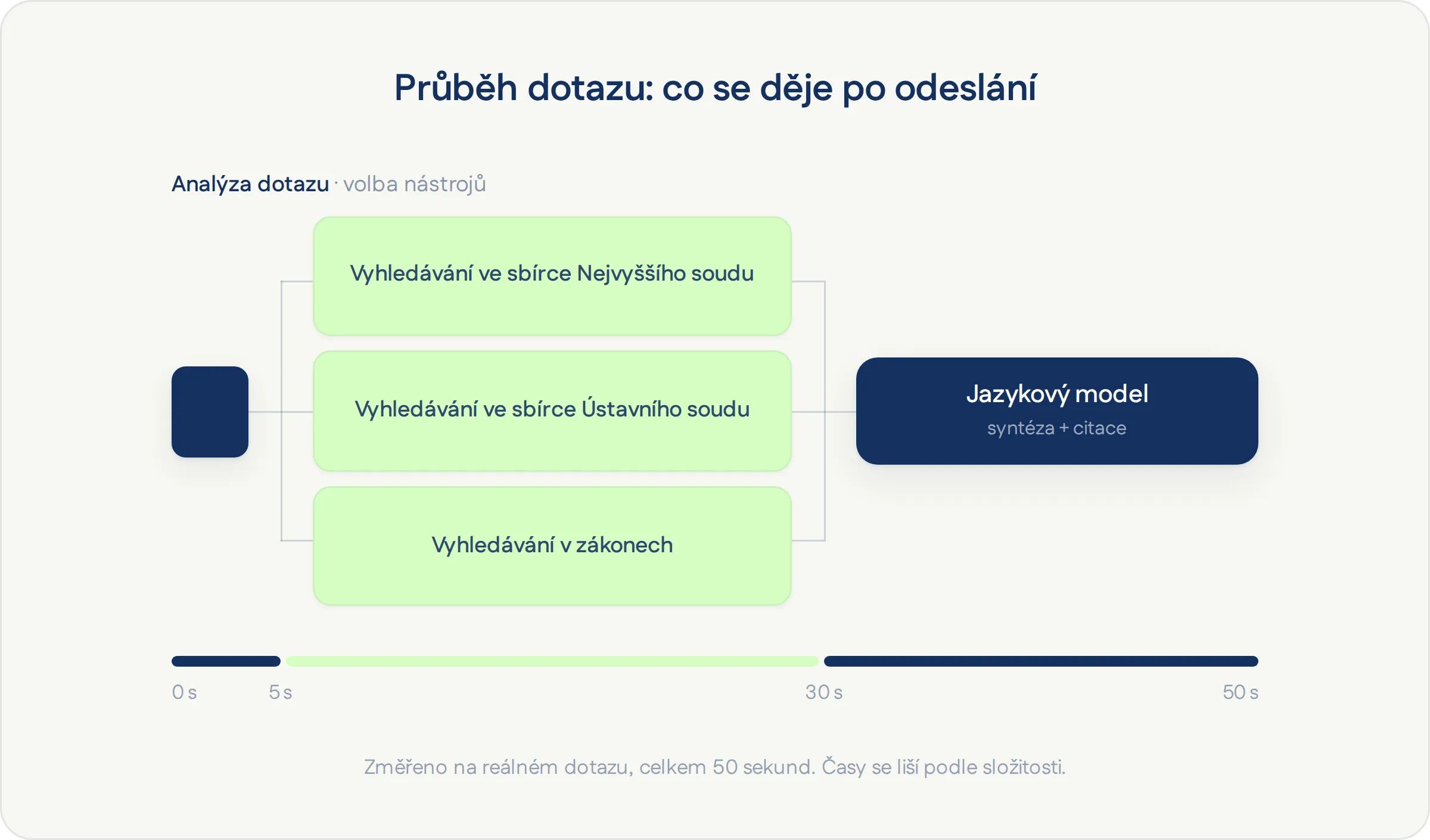
What happens to a question after you send it. The widths match the measured time, so it is visible that most of the minute goes into searching, not into writing the answer. Measured on a real question, 50 seconds in total; times vary with complexity.
Contextual search: why keywords are not enough
The opening question shows the basic weakness of full text search. The lawyer writes ‘WhatsApp screenshot’. Full text search would genuinely find part of the relevant case law; some decisions use the word screenshot literally. But the decision that weighs most on the answer reasons in terms of balancing protected rights and interests, and in terms of a recording made by a private person; the word screenshot never appears in it. Search by word match walks past decisions like that, even though they are the ones that settle the answer.
Contextual search therefore works with embeddings: the text of the question and the texts of the sources are converted into a vector representation of meaning, and their proximity is compared. A question about a WhatsApp screenshot then also reaches the decision about a recording made by a private person, because in substance it is the same thing, only in different words.
There are dozens of embedding models and they differ markedly on legal text. We therefore measure their performance continuously on our own set of questions. The model in production is always the one with the best results on that set. In our measurements this choice affects the accuracy of the answer more than the choice of language model does, it is simply not visible from the outside.
The second pillar is the corpus. It is updated daily; from the moment a court publishes a decision to the moment it is available in the system, a few days typically pass, taken up by processing. And it is not stored as raw text. We process every document in advance and label its parts: where the operative ruling sits, where the reasoning sits, and which passage carries the point of law. The search then does not aim at the document as a whole, but at the specific relevant passages.
Parallel processing: where that minute comes from
The volume of sources searched is the same as it would be if the tools ran one after another; only the time differs. Because they run side by side, the whole research phase fits into 20 to 30 seconds, and the path from question to cited answer into under a minute.
Longer generation does not mean higher accuracy
When generating an answer takes five minutes, one of two things is usually going on. Either the processing is needlessly sequential, with steps waiting on each other when they could run side by side; that is low efficiency, not higher quality. Or the bulk of the work is done by one large language model that pulls an enormous volume of documents into its context window and goes through them itself. It looks thorough, but the method is imprecise: as the context grows longer, the model becomes less reliable with individual details, and the relevant passages are diluted in the noise.
Some models do genuinely improve their output by ‘thinking’ for longer, typically on mathematics or code. Legal research is a different task: no amount of thinking replaces a source the search never brought back.
Specialised components do the opposite. Embedding search finds the candidates, the research tools narrow them down to the relevant passages, and the language model receives only concentrated material to synthesise. Each step is handled by one component built for it. The result is faster and more accurate at the same time; speed here is not a trade-off, it is a symptom of the architecture.
The reverse equation does not hold either: faster is not better by default. What matters is that time on its own is not a quality metric. Judge an answer by the correct interpretation of well-cited sources, in which you find exactly the piece of information you need when you open them, not by how long you waited for it.
The language model: a replaceable part (today Gemini 3.5 Flash)
The last phase belongs to the language model. It receives the question and the sources that were found, and builds a cited answer from them. It does not cite from memory but from the documents in front of it; the risk of a fabricated citation drops sharply. Of the 50 seconds the whole process takes, roughly 20 fall to this phase: the system spends most of the time searching, not writing.
At the time of writing, Gemini 3.5 Flash is in production. As a rule we use the strongest class of language models currently available, suited to the context size in question. We test new models constantly and swap in newer ones. We are not tied to any single supplier. On the higher plans the user can choose the model.
The alternative to the strongest available models is local models running on DirectCase servers. They offer the highest level of security. Local deployment does however mean by definition that they cannot be the best available. Given our architecture that is not much of a drawback: synthesising the answer is not the hard part of the chain. Everything before it is.
Your own model through the connector: DirectCase as a data layer
A practical consequence follows from all this: in DirectCase the language model is a replaceable part. And it does not even have to be ours.
So we offer a connector. It is a link that brings the verified DirectCase corpus and search straight into your own AI tool. You then write your question in Claude, for example, and Claude draws on our data at mcp.directcase.ai.
Two paths lead into the data layer, each for a different way of working. The DirectCase application is the whole chain described above: parallel research, merging of results, synthesis and the environment of relationships between decisions, tuned as a single whole, with the model included in the price; one subscription gives you everything at once, from the data up to the strongest available model. The connector opens our data layer, the corpus and the search, inside your own AI tool; what the model then does with it is governed by the tool on your side. For research you need to rely on, the application is the complete solution. The connector is for anyone building their own way of working who wants our data in it. Details are on the page of the MCP connector for legal sources, pricing on the home page of DirectCase legal AI.
Both paths rest on the same foundation. We do not sell a model. We sell the verified legal reality the model looks into.
Hosting, confidentiality and limits
Questions are processed on servers in the EU, specifically in Germany. Neither we nor the companies where the question is processed train on your questions. A question you ask stays a question; it does not become training material.
And the limits of the system: the hardest discipline in legal research is case law that has been overruled. A decision can be overruled on a single word or on its whole substance, and telling the difference is demanding even for a senior lawyer. All the more so for an AI model. That is why we mapped the relationships within case law, built them into the search algorithm, and you see them visualised when you open a decision. You judge the nuance yourself. The system prepares the material in a minute; the legal judgment stays with you. That is deliberate.
You will not find the answer to the opening question here, and that is on purpose. Put it to DirectCase yourself; there is no better test question, because you now know exactly what happens to it inside. In fifty seconds you will find out whether a screenshot holds up in court. And whether this article holds up with you.
Models will keep changing, and faster every year. Anyone who builds value on the model rebuilds the foundations every quarter. We laid ours one layer lower: in the data we process every day, and in the search that can find it.